
intro
Starting digital marketing can be overwhelming.There are so many avenues, channels, tools, tactics, and opinions. And the good news is that you don’t need to know everything. In fact, over your first 30 days you can set up a strong foundation, have a fully launched campaign, and know enough to make smart choices about what to do next.
This 30 day email course is for people who are brand new to digital marketing and want actionable tips they can use right away, not just theory. This course is for small business owners, the self employed, or anyone considering a future in digital marketing who is looking to go from frustrated and confused to educated and ready to take action in just 30 days.

Why Your First 30 Days Are Important
The first month is about figuring things out. It’s about developing a skill set and finding your own process and system that you will continue to build on and add to in the future.30 days is enough time to:
- Define your audience, goal, and message.
- Learn the different digital marketing channels and how they all work together.
- Set up and start using tools like Google Analytics, a business profile, and other social media sites.
- Review everything and see what you will continue to do or not do in the future.
- Actually create your first pieces of content.
- Run your first small campaign.
It’s about getting results, not necessarily about being perfect. You will learn so much about digital marketing in 30 days of active use compared to 30 days of just watching someone else do it.
Before You Start: Clarify Your Starting Point
Before working on your daily plans, take a little time to think about your situation at the beginning of the journey. It will help you make the best choice of the channel, goals, and activities.
Define Your Role and Goal
Are you learning digital marketing to take your own business to the next level, do it for someone else, or get a new skill for your resume? Depending on your selection, we will create the right strategy for you.
The goals that we can set together are:
- Getting more leads or enquiries for your service-based company
- Generating online sales for your e-commerce site
- Building a personal brand and social audience
- Learning digital marketing to become a specialist in the industry
- Boosting the online visibility of your local business.
Now, let us set SMART goals for you. For instance, if you choose the first option, we can set the objective “get 10 highly-qualified leads in the next 30 days.” Another example: “increase Instagram followers from 0 to 500,” “publish 4 high-quality blog posts per month,” “set up Google Analytics and track conversions on my website,” “run one small-scale Google Ads campaign or Meta campaign,” and many others. A simple goal will create a solid foundation for our strategy as a clear vision is a paramount element in any business.
A specific goal makes it easier to choose the right actions and measure success.
Identify Your Audience
You can’t market to someone if you don’t know who they are. Spend time identifying your target or ideal customer or audience.
Answer these questions:
- What problem do they need to be solved?
- Who are they? (age: where are they located, job function, interests, etc.)
- What words do they use to describe the issue?
- Where are they spending time online? (Google, Instagram, LinkedIn, YouTube, etc.)
- What would make them choose you or trust you?
You don’t need a fully fleshed-out customer persona. A basic one-paragraph description will suffice.
Choose 1-2 Core Channels
It is common for people to start promoting their business using all available marketing channels. However, it is better to begin with one or two channels, focusing your efforts on them. Below are some ideas concerning what channels to choose and how to use them in the first 30 days.
- Use Google Search and a Landing Page for Local Services and High-Intent Searches
- Use Instagram or Facebook + WhatsApp or Email for Most Consumer Businesses
- Use LinkedIn + Email or Blog for Most B2B Sales-Oriented Businesses
- Use YouTube + Lead Magnet + Email List for Coaches and Educators
- Use SEO + Content Marketing for Long-Tail Sales Growth
In the first 30 days, concentrate on one or two channels that have the best chances of bringing you customers or growing your influence. All other marketing channels can be explored and added later.
Week 1 – Learn the Fundamentals and Set Up Your Accounts
This week you’re going to learn the foundations and set your accounts. Before you launch into any campaigns, take the time to understand the fundamentals.
Days 1-2: Learn the digital marketing basics
Get familiar with fundamentals of digital marketing and gain an understanding of how major marketing channels work.
What to study:
- The definition of digital marketing and its differences from traditional marketing;
- Digital marketing channels: SEO, content marketing, social media, email marketing, Paid Ads (Google Ads, Meta Ads), and analytics;
- The customer journey: awareness, consideration, decision, and retention stages;
- Definitions of Impression, Click, CTR (Click-Through Rate), Conversion, Lead, ROI (Return on Investment), and CAC (Cost per Acquisition);
- Useful resources: Google Digital Garage, HubSpot Academy, Meta Blueprint, general marketing blogs.
- Make a list of questions that you have while learning the material and try to find answers to them later while practicing.
Days 3–4: Define Your Offer and Message
Before doing any promotion, know exactly what you are promoting and how you will talk about it.
First,
- answer these questions:
- What are you promoting?
- Who is your target audience?
- What problems are they facing?
- What solution do you offer?
- How are you different from similar businesses?
- What action do you want the customer to take?
Then,
formulate a brief message that will become the basis of all your marketing materials: ‘We help [target audience] solve [problem] by [solution], so they can [benefit].’
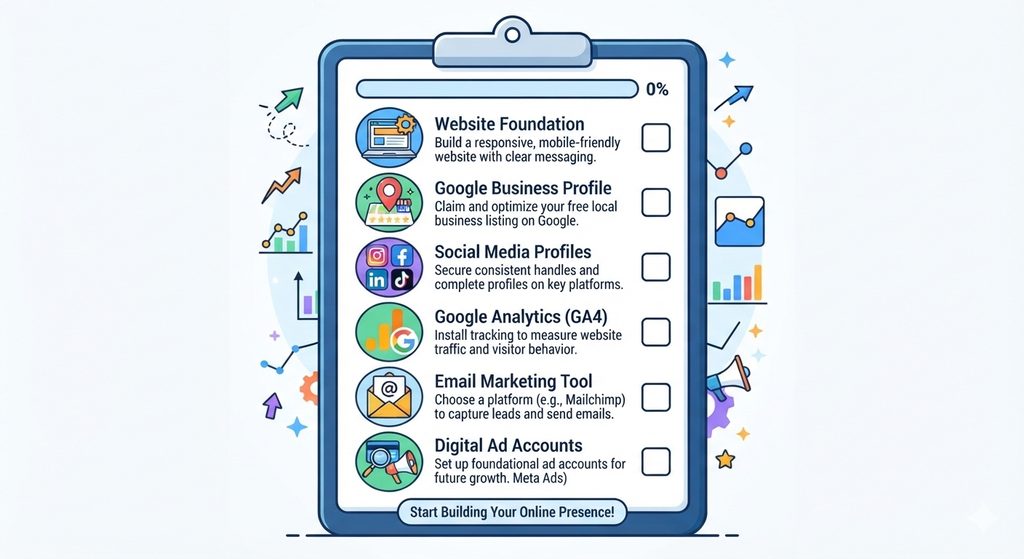
Days 5-7: Set Up Your Core Tools and Profiles
You need to create some marketing infrastructure. This stage takes care of the basics:
- Your website/landing page
- Google business profile
- Social media profiles
- Google Analytics
- Google Search Console
- Email tool
- Ad accounts (Google and Meta)
- All other tools and assets you want to use
- We’ll talk through each of these briefly.
First, your website or landing page. Any simple site or even a landing page with your offer, value proposition, proof, and contact info will do. You can use a tool like WordPress, Wix, Squarespace, or a simple landing page builder.
If you have a local business, set up your Google Business Profile and make sure you get your information verified. You’ll want to optimize your profile with photos, services offered, and contact info.
Next, set up social media profiles. You may only need one or two networks, depending on where your audience spends time. Make sure your bios are optimized, profile photos are recognizable, and you have contact info.
Set up Google Analytics with a Google Analytics 4 property. This will help you understand your traffic and users better. Then, set up Google Search Console to track how Google views your site.
Sign up for an email marketing tool such as Mailchimp, Bravo, ConvertKit, or HubSpot. Set up a simple opt-in form so you can start collecting leads.
Finally, set up your Google Ads and Meta Ads Manager accounts. You may not use them right away, but you need to familiarize yourself with the tools. Save all your login info and assets in one shared place so you can access them easily.
Week 2: Learn SEO, Content, and Audience Research
In week two, you will learn how people find businesses online and start creating content that attracts and engages your audience.
Days 8-9: Learn SEO basics
Search Engine Optimization or SEO is the process of optimizing your website so that it shows up in search results when someone types in a query related to your site. SEO basics will include:
- How search engines work and what they value (relevant, informative and trustworthy content)
- Keyword research (finding out what terms and phrases your target audience is searching for)
- Search intent (determining if someone is searching for information, a comparison or ready to buy)
On-page SEO refers to optimizing elements on your web pages such as title tags, meta descriptions and headings. It also includes internal linking and making sure your content is easy to read. On-page SEO is essential if you want to improve your Google ranking. If you have a local business, you should also focus on local SEO. This type of SEO is about showing up in “near me” searches and Google Maps.
Various free SEO tools can help you with keyword research. Some of the best free SEO tools include Google Keyword Planner, Uber suggest and Answer The Public.
Days 10-11: Plan Your First Content Pieces
Content is the backbone of any digital marketing strategy. It drives SEO, social media engagement, email marketing, and paid media.
During these two days, you need to plan:
- 2-4 blog post topics that will answer the most frequently asked questions by your customers
- 5-10 social media posts (tips, behind-the-scenes, customer testimonials, FAQs, and quick wins)
- One lead magnet (a checklist, a guide, a template, a quiz, or a video series) that will help you collect emails from your leads
- 1-2 email marketing ideas for nurturing your leads
- And a simple content calendar for the next 30 days.
Days 12-14: Develop and Publish Your First Content
Now it is time to develop and post your first content.
Actions:
- Write and post your first blog article or service page with a target keyword.
- Create 3-5 social media posts using free online design tools (Canva)
- Record a short video or design a graphic about your main offer
- Write the first email to newsletter subscribers about your company and its benefits
- Add call-to-action buttons on your website and social media accounts (contact form, WhatsApp, links to appointments, etc.)
Do not be afraid to post the first version of something that will later be optimized.
Week 3 – Launch Your First Campaign and Start Promotion
Week three entails launching one’s first campaign and promoting their newly developed material within their desired medium.
Days 15–16: Choose and Prepare Your First Campaign
Decide what type of campaign you want to launch based on your objective and chosen channels.
For example, you may want to
- launch a small Google Search Ads campaign targeting specific keywords,
- run a Meta (Facebook/Instagram) ad promoting a lead magnet or limited-time offer,
- create a LinkedIn post campaign and connection outreach sequence for B2B services,
- plan an Instagram or TikTok content series with a call-to-action,
- or design an email sequence for new subscribers encouraging them to book a consultation or make a purchase.
Prepare the necessary assets for your selected campaign, including a compelling offer, landing page or destination URL, strong call-to-action, and basic tracking parameters (UTM tags, Analytics or Ads conversion tracking).
Days 17 – 19 – Launch & Promote
Now it’s time to launch and promote the campaign.
Actions to take:
- Launch the ad campaign with a small daily budget that you are willing to invest and test.
- Publish the scheduled social media posts.
- Share the link to your blog post or lead magnet.
- Send the first email to your subscribers.
- Reply to all the questions and comments.
- Do not optimize the campaign too early. Let it run for at least 48 hours to gather statistics.
Days 20–21: Measure early performance
Monitor your campaign and content performance.
Review the following:
- Impressions or reach of your content or ads.
- Number of clicks or CTR (click-through rate).
- Submissions of forms, calls, purchases, and sign-ups.
- Top posts and ads.
- Early questions or feedback.
Keep track of content and strategies that are working well and those that are not. This information will help you optimize your social media campaign in week four.
Week 4: Measure, Optimize, and Plan the Next 30 Days
In your final week, focus on learning from your results and creating a sustainable plan for the next month.
Days 22-23: Analyze the Results
Now it’s time to take a closer look at your results. You should be able to answer several crucial questions at this point.
Did you meet your 30-day challenge goal? If not, how close did you get?
- What channel drove the most active users or leads?
- What content performed best?
- What is the cost per lead or cost per result for your paid channels?
- What obstacles or pleasant surprises did you encounter?
Use Google Analytics and other data and research tools mentioned in the previous week’s material to research these points.
Days 24-25: Take your best assets and optimize them according to the insights you’ve discovered
Things to do could be:
Modifying the headlines and calls to action of your most successful landing page.
- Creating more content similar to your most shared and linked to content.
- Pausing the ads that are performing poorly and reallocate the budget to the high-impact ads.
- Tweaking your audience targeting based on who is engaging and buying from you.
- Asking for questions and testimonials for the FAQ section.
Remember: It’s always better to make small adjustments and test them rather than make random, drastic changes.
Days 26-28 – Document Your Learnings
Document everything you learned during your first 30 days. It will become a guide for your next 30 days.
In it, you’ll want to document:
- What worked and should continue
- What didn’t work and should change or stop
- Tools that were helpful or want to explore
- New ideas you want to try
- The skills you want to develop (writing better copy, learning how to create better ads, improving your analytical skills, etc.)
Doing this exercise ensures you don’t repeat the same mistakes and learn from your successes along the way.
Days 29-30: Plan Your Next 30 Days
what you learned about your business to put together a plan for the next month.
Use Decide:
- Your next primary goal (e.g., double leads, improve conversion rate, launch a new content series).
- Which channels you’re continuing (and whether you will add one new channel).
- Your content strategy for the next four weeks.
- Your budget and time allocation for ads, tools, and creation.
- How often you’ll examine your performance (weekly is a good start).
Digital marketing is a process involving a constant cycle of testing, learning, and tweaking. Your second 30 days should build on the groundwork you’ve laid in the first.

Common Beginner Mistakes to Avoid
- While going through the first 30 days, it is essential you avoid the following common mistakes.
- Multi-channeling when you should be narrowing
- Having vague goals (more traffic – what does that mean?)
- Launching before having a proper offer, landing page and tracking set up
- Not catering to the mobile audience and page speed optimization
- Inconsistent social media posting
- SEO is not a quick win
- Only tracking likes and followers, not leads and sales
- Not nurturing the leads and being timely in responding
- Avoiding these mistakes will save you time and money and get you better results in the short term.
conclusion
Everything you need to know on the first 30 days marketing to gain pace with the game. By the end of the month, you should already know your audience better, have your digital presence, created your first content, and seen off your first campaign with real-time results.
Focus on this information to make your next 30 days even more productive. Remember that succeeding in digital marketing entails constantly iterating and optimizing. In addition, keep your efforts concentrated on working on too many areas which at the same time will not yield desirable results. Try to work only on the two most productive areas.
If you manage to follow these guidelines, you can be confident that in the next 30 days, you will become much more competent and organized in digital marketing than you were at the beginning of the journey.