Introduction
If you’ve just begun to run a business, you’ve most likely heard some mixed opinions on marketing. While one person will tell you to go ahead and start running Google Ads, another will advise to focus on SEO exclusively. And a third will recommend to sit back, relax, and wait for Instagram to deliver customers on a silver platter.
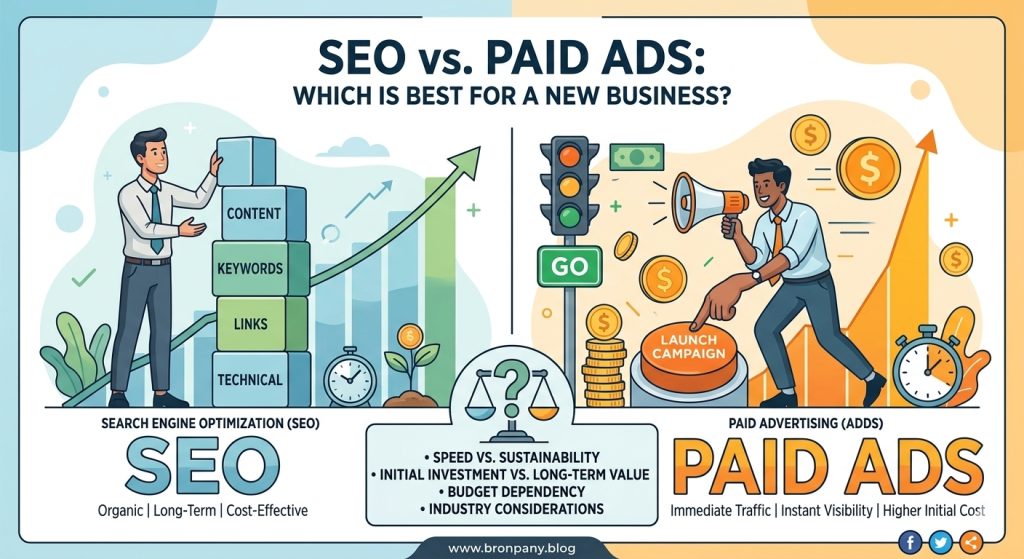
The first question that new business owners ask at ThikListing is about the choice between paid ads and SEO. The answer, as you might have guessed, is that it’s situational. It depends on your budget and timeframe, among other things. But that’s not an answer, really – that’s just passing the buck. So here’s our attempt at a thorough explanation of the differences between the two, why they might be beneficial, and under which circumstances each should be used.
What Is SEO?
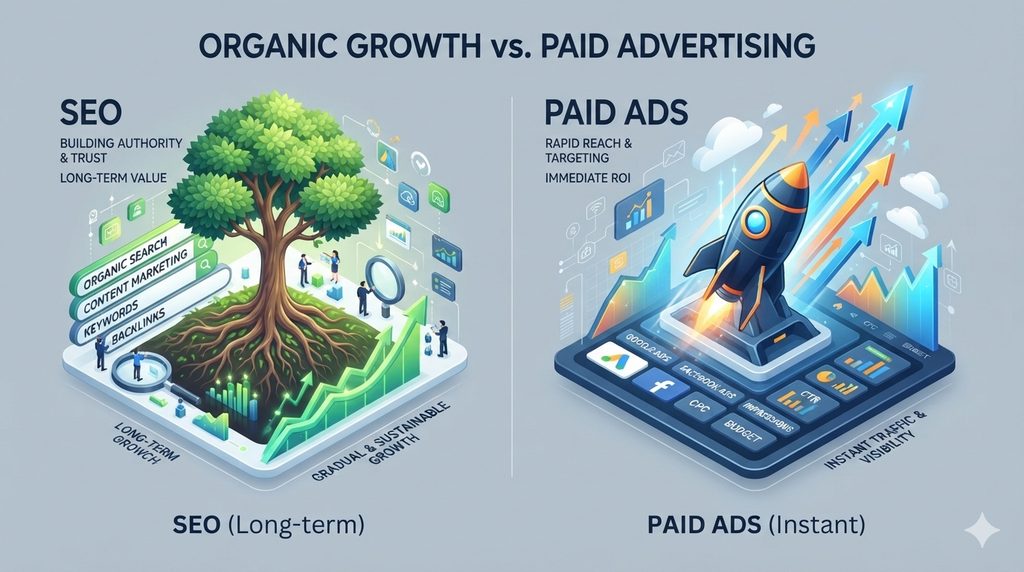
SEO, or Search Engine Optimization, is the process of optimizing your website so that it appears higher in organic (non-paid) search engine results. SEO encompasses a variety of tactics centered around writing quality content about your products/services, targeting keywords, improving technical aspects of your website, and building backlinks.
What Are Paid Ads?

Paid ads are online advertisements that are paid for separately from organic search results. Google Ads, Meta Ads (Facebook & Instagram), and LinkedIn Ads are the three major platforms for running paid ads. Each platform has its target audience; however, the core mechanic is similar. In most cases, the ads are paid for through a pay-per-click (PPC) basis, meaning that you only pay when someone clicks on your ad.
The easiest way to distinguish between the two is to think of them as renting vs. buying. With paid ads, you’re renting the space for your ad, whereas with SEO, you’re buying traffic to your website.
The Case For Paid Ads
While new business owners often dismiss ads as expensive and ineffective, they have a few major benefits.
They’re fast.
You can launch a campaign this morning and have paying customers by tonight. If you need to get traffic to your site this month, paid ads are often the only viable option.
They allow you to test whether there’s demand
For example, if you’re on the fence about whether customers would be interested in a new product at the price you want to sell it for, a small-scaled ad campaign will help you narrow that down in a matter of weeks. SEO, on the other hand, often takes months to begin showing results.
They have excellent targeting options.
You can target your ads based on a person’s age, gender, interests, location, behaviors, and even the search queries that got them to your ad. Paid ads are some of the most sophisticated tools available in terms of targeting.
They’re easily measurable and have a clear cost-per-conversion.
You know how much you spend on ads and how much traffic they drive to your website, which will in turn show you how much money you earn per dollar spent on ads. With a proper setup, there’s little risk in running a small-scale ad campaign to test the waters.
However, ads have one major, fatal flaw – the second you stop spending money on them, your traffic is gone. Another problem is that the cost-per-click tends to increase as time goes on, as more competitors begin to bid on the same keywords. And if you have a poorly optimized website, you’ll begin to waste money on ads with no conversions. Sending traffic to a shoddy, non-optimized landing page is one of the most common mistakes that new businesses make when using paid ads.
The Case For SEO
SEO is a slower process, but the results it delivers are long-lasting.
Unlike ads, SEO will continue to generate traffic to your website long after you’ve begun working on it – in some cases, for years. SEO also builds credibility. Because many people skip over paid ads, ranking #1 in organic search results builds trust with customers. SEO builds brand recognition. If you’re able to consistently write articles that answer your customers’ questions, they’ll begin associating you with those answers and come to your website to find solutions to their problems. SEO also becomes more cost-effective over time. The first few months will require a steady effort with little reward, but eventually, you’ll notice that the traffic you begin to receive requires almost no effort at all to obtain. With content marketing, your articles can live on the website almost indefinitely, continuing to generate traffic. Unlike ads, which renew themselves every day, SEO has a very low ongoing maintenance cost.
The main drawback of SEO is that it takes time. There’s no magic pill that will get your website to#1 in search results in a matter of days. SEO requires patience – at least 3-6 months of consistent effort before you begin to see real results. And for newer websites, it can take even longer to see results, as Google needs to recognize and trust the domain. And finally, SEO is much harder to measure, as the results are entirely dependent on your ability to optimize your content properly.
A Summary of Differences Between SEO and Paid Ads
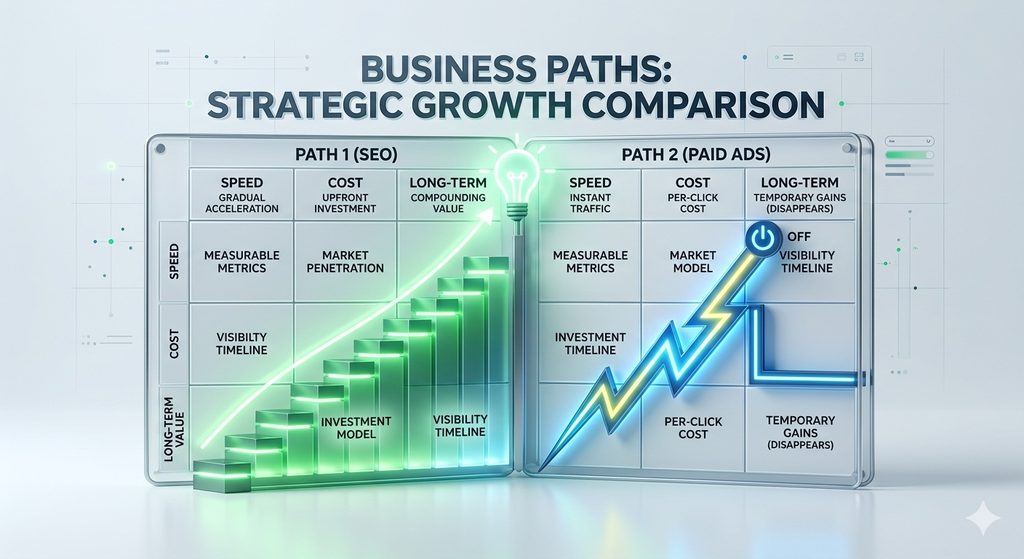
| Factors | SEO | Ads |
| Time to results | 3to6 months | hours Days |
| upfront cost | Low to Moderate | Moderate to high |
| Cost | Over time | Decreases Increases |
| Traffic after stopping | Increases | Stays the same |
| Best use case | Long-term traffic | short-term sales |
| Primary risk | Take too long | Wastes budget if poorly manage |
So Which Should You Choose?
If you’re looking for a quicker source of traffic and sales, paid ads are the way to go. If you’re looking to build a sustainable source of traffic, SEO is a much better option. If you’re looking to build a sustainable source of traffic, SEO is a much better option.
You should consider using paid ads if
you need paying customers in the next couple of months,
if you’re not sure there’s demand for your product or service,
if you have a strong offer and a well-optimized landing page,
and if you’re willing to invest in ongoing maintenance.
Meanwhile, you should consider SEO
if you have a very limited budget,
if your customers are likely to research before buying (such as with services, courses, digital products, or local businesses),
if you’re looking to build long-term brand awareness,
and you’re willing to create content consistently.
If you’re not sure which to pick, use both.
They actually complement each other quite well. A proper strategy would involve using a small part of your budget to advertise while the rest goes into SEO content creation. Once your content begins to rank, you can shift more of your budget there while using ads to supplement.
The Smart Strategy: Use Both, But In Different Ratios
To understand the strategy, imagine it as a relay race. You begin with a small-scale ad campaign while simultaneously putting your SEO content creation efforts into preparing for the long game.

In the first 3-6 months: launch an ad campaign with a small budget and target a few keywords. Make sure that the landing page you send traffic to has a clear offer that encourages visitors to make a purchase or provide their contact information. Simultaneously, begin researching keywords to write about. Once your ad campaign has begun to run, analyze which keywords performed well and begin integrating them into your SEO content. Because ads are much faster at providing results, you’ll be able to see which keywords are worth pursuing. You can even use your ad budget to research keywords by narrowing in on the ones that have conversion rates.
In the next 6-12 months: once you’ve seen some results with your ad campaign, begin shifting some of your budget into SEO content creation. Begin publishing articles around the keywords you’ve identified and begin shifting some of your ad budget away from keywords that you rank for organically. Your ad campaign will serve to supplement your organic traffic, rather than the other way around. After a year, you’ll have a sustainable source of traffic with little required upkeep.
Common Mistakes New Businesses Make

- Thinking that SEO takes 30 days to produce results. If someone is promising to get you on page one of Google in under a month, be very, very skeptical. There are some long-tail keywords that can help, but most of the time, it’s a ploy to get you to sign up for a package of services.
- Investing in ads before optimizing your website
- 1
- If you have a slow website, a poor mobile experience, or unclear value proposition, invest in optimizing those before spending money on ads.
- Trying to rank for keywords that are too broad
- As a new business, you can’t compete with the big players for keywords like “digital marketing agency” or “running shoes.” You have to get specific with your targeting. “Running shoes for flat feet under ₹3,000” is a battle that you can win as a new business.
- Not tracking your results
- Make sure you set up Google analytics and conversion tracking so that you know what’s working and what’s not.
- Giving up too soon
Both SEO and ads require patience and testing. Three weeks is not enough time to give up and walk away. Stick with it for at least 3-6 months.
How To Split Your Budget Between SEO and Paid Ads
A good rule of thumb is to set aside 70% of your budget to SEO content creation and 30% to small-scale ad campaigns if you’re operating on a very tight budget. If you’re not sure whether to focus on SEO or ads, split your budget 50/50 for the first six months before reevaluating. If you need to get customers right away, set aside 70% of your budget to ads and 30% to SEO. That way, you’ll be able to recoup some of the money spent on ads with the revenue from sales. After two or three months, you can reevaluate.
Our Honest Opinion
Don’t think of this as SEO vs. ads. Think of it as ads for the short term and SEO for the long term. A business that only advertises is one click away from bankruptcy. And a business that only does SEO can find itself in dire financial straits if their optimization efforts fail to pay off.
Start with a small budget for ads to get some traffic and see what keywords to focus on, and supplement with SEO. In a year’s time, you’ll have a sustainable source of traffic and sales, with little required upkeep. If you’d like help figuring out how to split your budget between the two, the team at ThikListing is happy to help. You can contact us here for a consultation.
Frequently Asked Questions (FAQ)
- Is SEO better than paid advertising for a new business?
SEO and Ads each have their strengths and weaknesses. SEO is typically more cost-effective and sustainable in the long run, whereas Ads typically produce faster, more immediate results. Both methods are beneficial to a business, and a combination of the two is typically the most effective strategy, especially for a new business.
- How long does SEO typically take to produce results for a new business?
It typically takes 3-6 months to begin seeing results from SEO, with some industries taking as long as a year. SEO takes longer for new domains because search engines need to recognize and trust the domain before boosting it in the search results.
- How much should a new business spend on Google Ads?
There is no correct answer, but most small businesses begin with a monthly budget between ₹10,000 and ₹30,000 to begin seeing results. Begin small and measure the results before increasing the budget.
- Can a business owner do SEO on their own, without the help of an agency?
You can definitely do SEO on your own, at least at the entry level. As your business grows and requires more optimization, you might want to hire an agency to handle the technical end so that you can focus on running the business.
- What happens if you stop running ads for a business?
You stop getting traffic from ads almost immediately. Unlike SEO, which has long-lasting benefits, ads only show while they’re running.
- Which is more cost-effective for a business in the long run: SEO or Ads?
SEO, typically, has a much lower cost per visitor than Ads. While you might have to spend more money upfront, the content created for SEO can continue to generate traffic for little to no additional cost. With Ads, the cost-per-visitor almost always increases over time.
- Should a business run Ads while doing SEO?
Yes, in fact, it’s often the best way to utilize both methods. While SEO builds long-term traffic, Ads will generate revenue in the short term.
- Should a business get a website before running ads?
Yes, absolutely. While it doesn’t have to be anything fancy or beautiful, a website with a good mobile experience and a clear value proposition is required before running ads. In the meantime, you can use social media platforms to run ads.
- What is the biggest mistake that new businesses make when it comes to marketing?
The biggest mistake that new businesses make is to expect too much too soon. Many new businesses fail because they expected SEO to produce results in less than a month, or they tried running Google Ads without having a well-optimized landing page.
- How can ThikListing help my new business?
ThikListing can help your new business by advising you which marketing methods to use depending on your budget and business goals, setting up the necessary tools and resources to begin, and helping you track, optimize, and measure the results.
Final Thoughts Words To The Wise
It’s important to keep the long game in mind, but you can’t build castles before laying the foundation. Take stock of your budget and decide what’s feasible within your timeframe and begin. Experiment, measure the results, and refine. A good place to start is to make sure you’ve set up analytics and begun measuring the results of your campaigns.